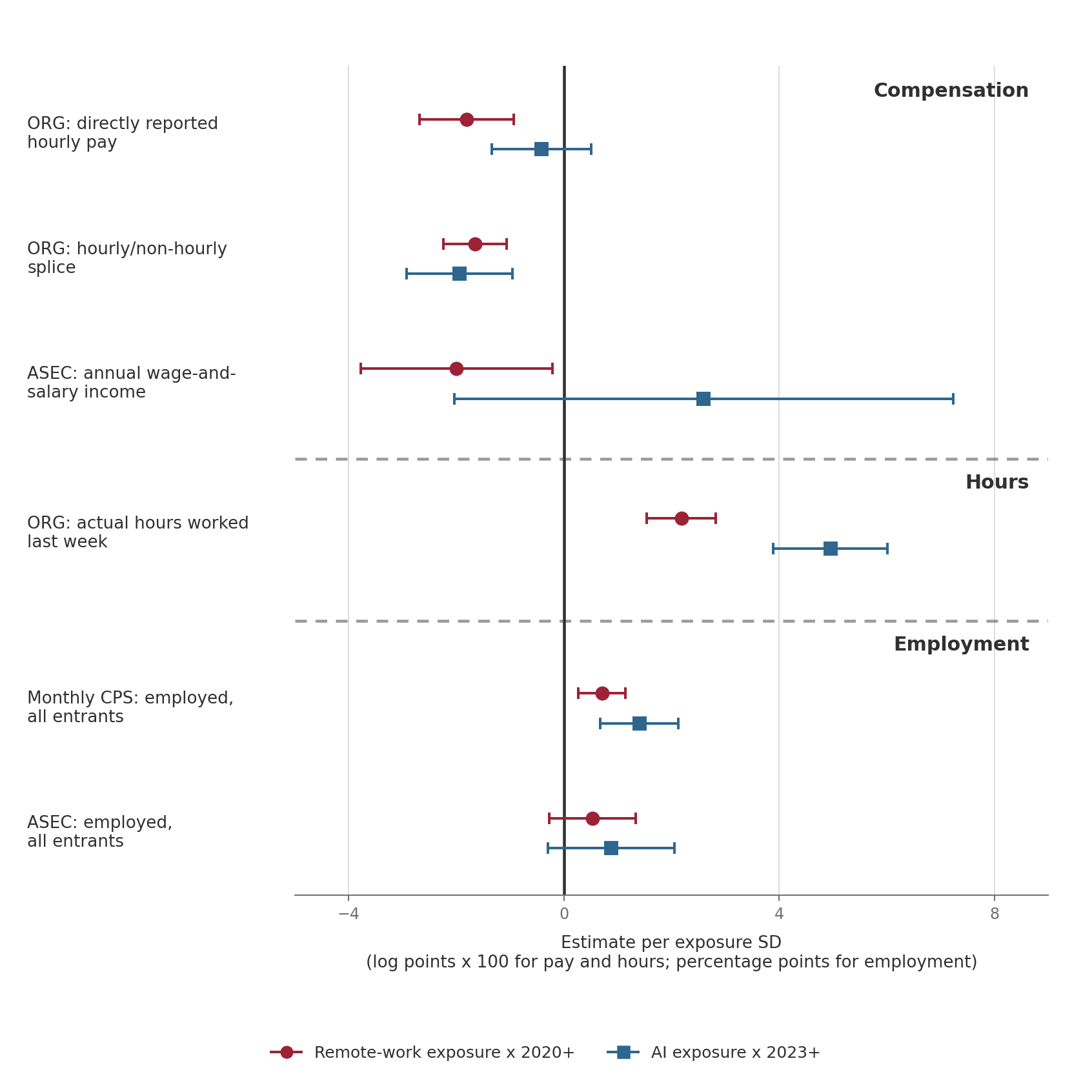
Abstract: In this study, I exploit the difference in timing between the mass adoption of remote work in 2020 and generative AI in 2023 to estimate separate exposure gradients for each technology at labor market entry. I find a one-standard-deviation increase in remote work exposure predicts 1.81% lower hourly pay and 2% lower annual wage-and-salary income. I do not observe a stable wage or employment effect from AI exposure. For AI exposure, compensation estimates only fall when hours vary, and employment estimates are sensitive to the assumed remote-work path after 2022.
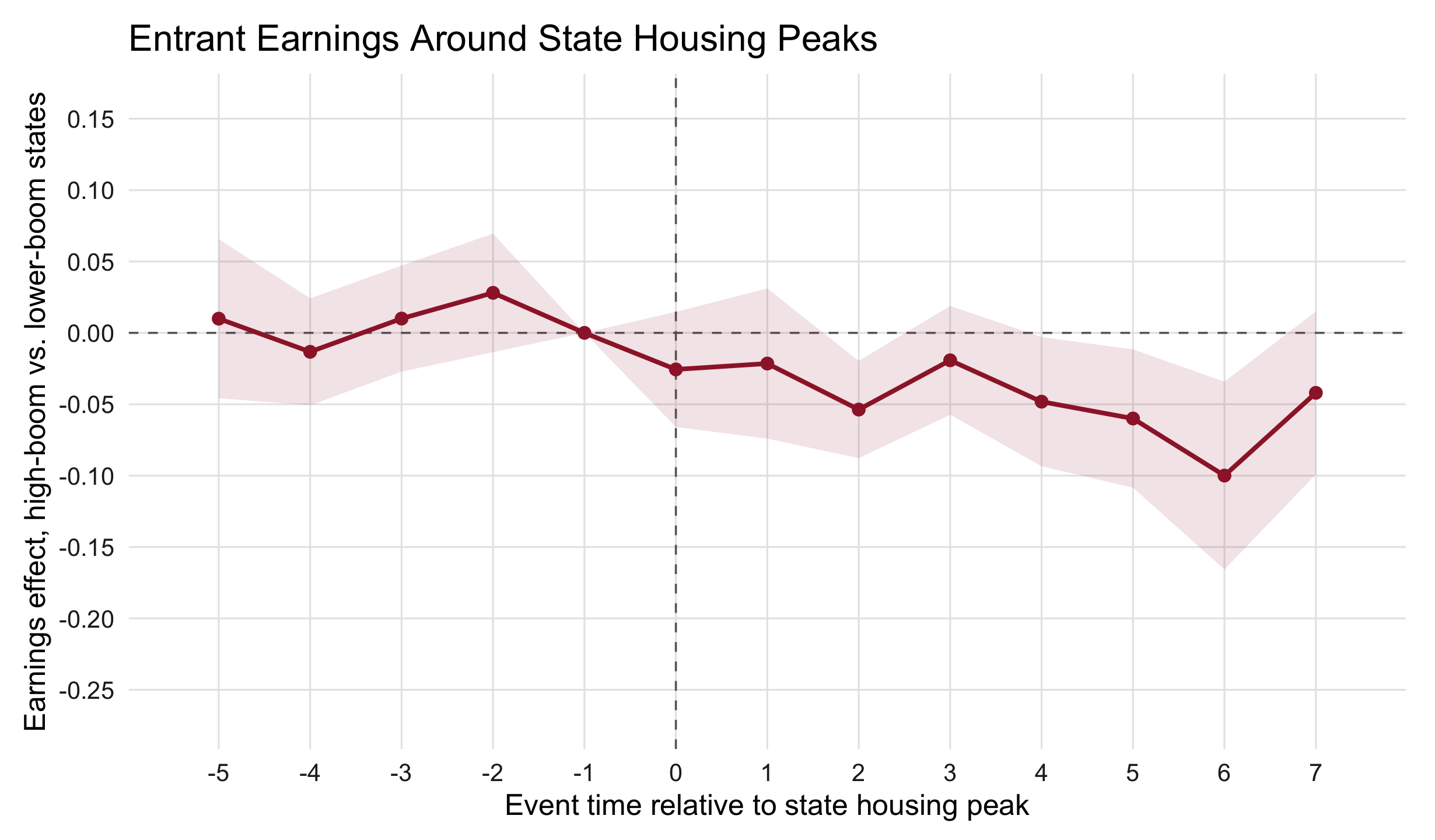
Abstract: Are there labor-market costs to starting a career after a local housing boom turns? I use repeated cross sections from the Current Population Survey Annual Social and Economic Supplement (CPS-ASEC) to compare entrant cohorts in high-boom states with entrants in lower-boom states around state housing peaks. Cohorts entering after the peak in high-boom states earn 5.7 percent less, and 8.2 percent less in the late post-peak window. Randomization inference and American Community Survey state-of-birth checks support the earnings result, and Quarterly Workforce Indicators new-hire evidence points to a weaker entry ladder.
Imported Price Pressure, Local Demand, and Early-Career Wage Scarring
Previously titled Wage Price Spiral at the Start of Your Career
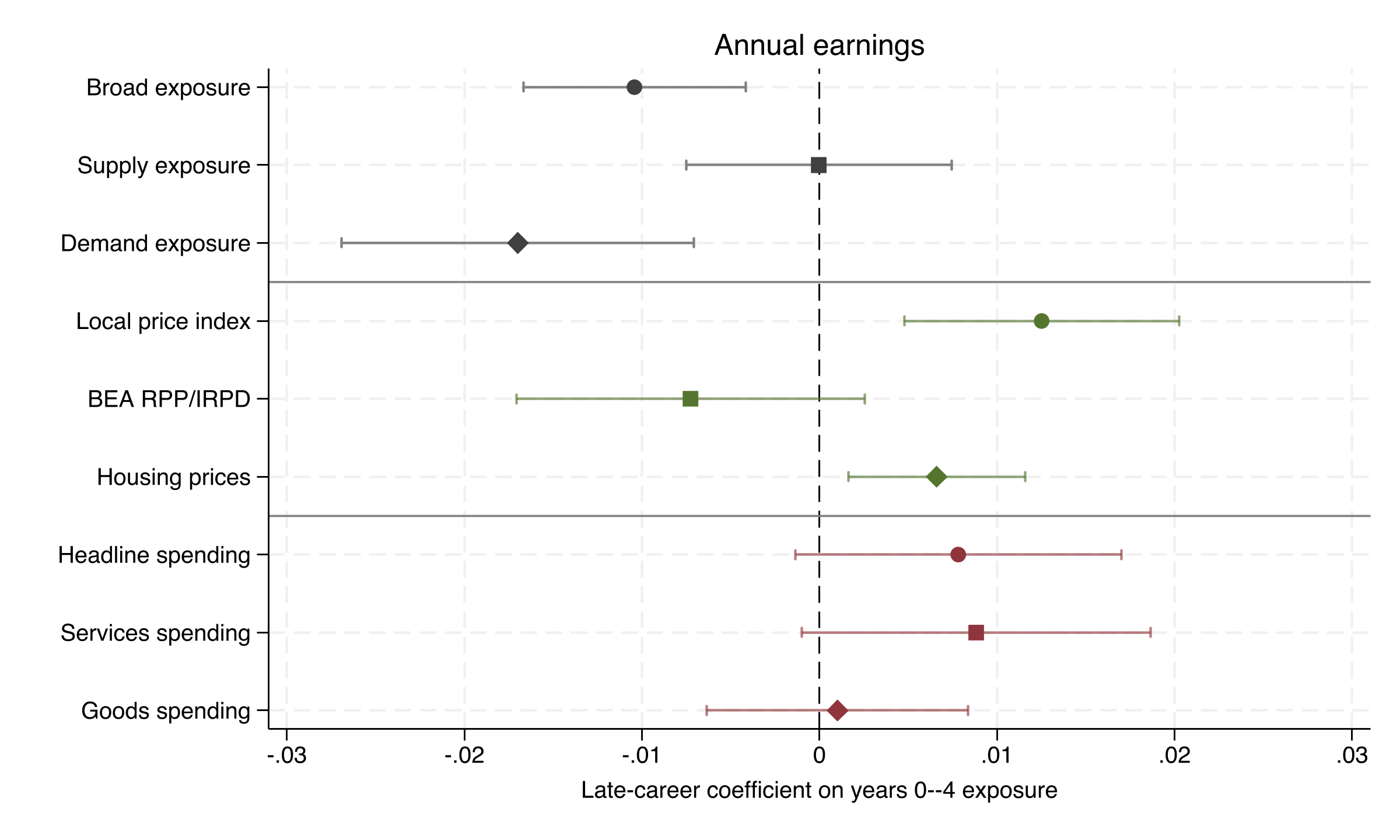
Abstract: Does the nominal environment a worker experiences early in their career matter? In this study, I compare how changes in imported price pressure, local price growth, and state spending growth early in a career can shape later wages and employment. I find that a one standard deviation increase in imported price pressure during the first five career years reduces annual earnings by 1.04 percent and employment by 0.54 percentage points in years 6 to 15. Realized local prices raise earnings by 1.25 percent. State spending growth raises employment.
How Increased Labor Demand at the Start of Your Career Can Improve Long Run Outcomes
Revise and Resubmit at Oxford Bulletin of Economics and Statistics
PDF | Markdown | Figures & Tables
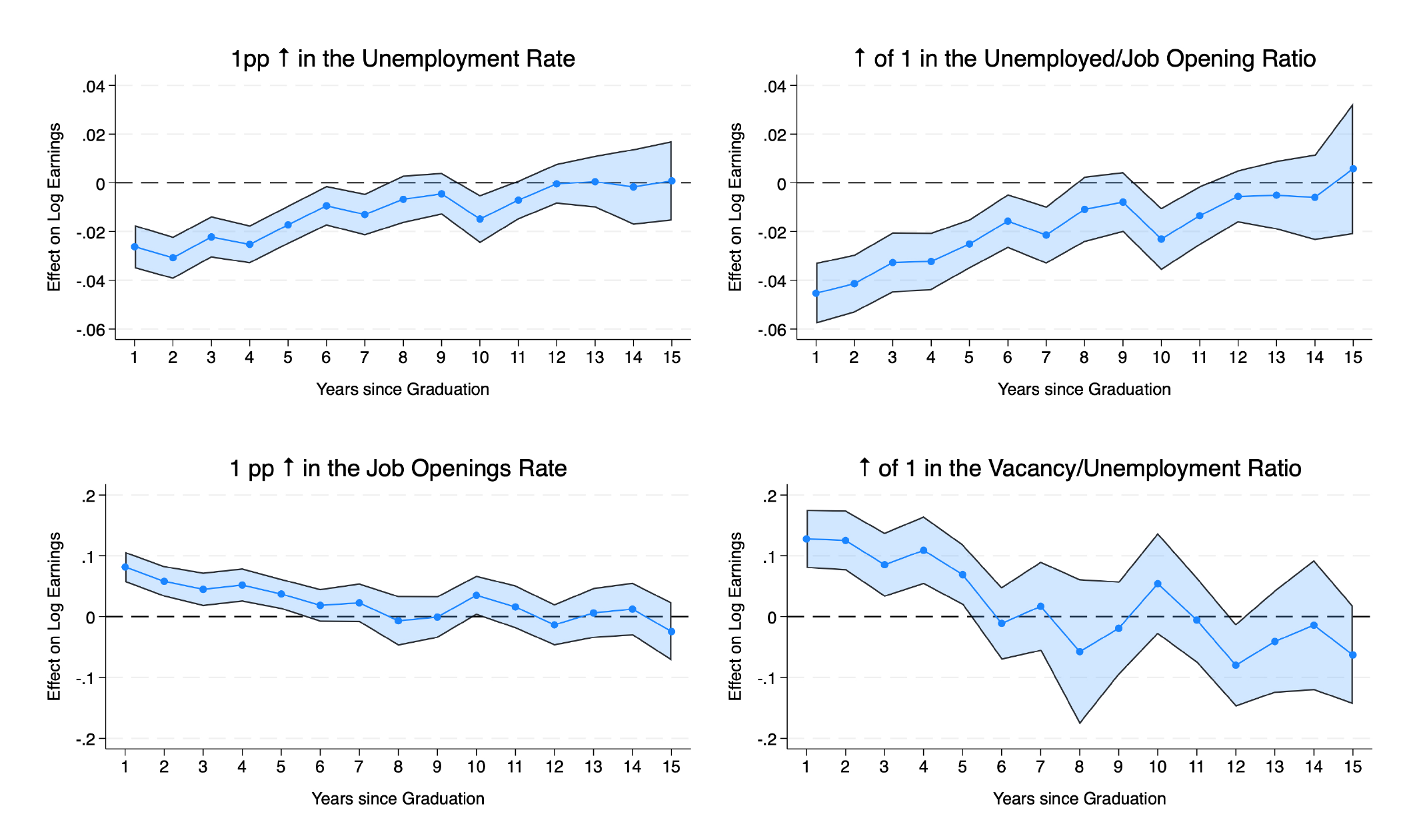
Abstract: This paper sheds new light on the channels through which labor market tightness at career start shapes long-term wage trajectories. Leveraging state-level Job Openings and Labor Turnover Survey (JOLTS) data, I find that initial conditions, such as the job openings rate and vacancy-to-unemployment ratio, have substantial, persistent effects on earnings over 15 years. Unlike previous studies that rely primarily on unemployment rates, this analysis captures more nuanced aspects of labor market conditions that significantly impact career trajectories. Extending the job ladder model to distinguish conditions at labor market entry from later labor-market conditions, I provide a mechanism whereby initial placement and gradual job-to-job mobility determine the magnitude and persistence of initial wage gaps. By quantifying the long-lasting impact of early-career labor market conditions and identifying job mobility as a critical channel, this paper opens new avenues for research on wage dynamics and labor market policy.
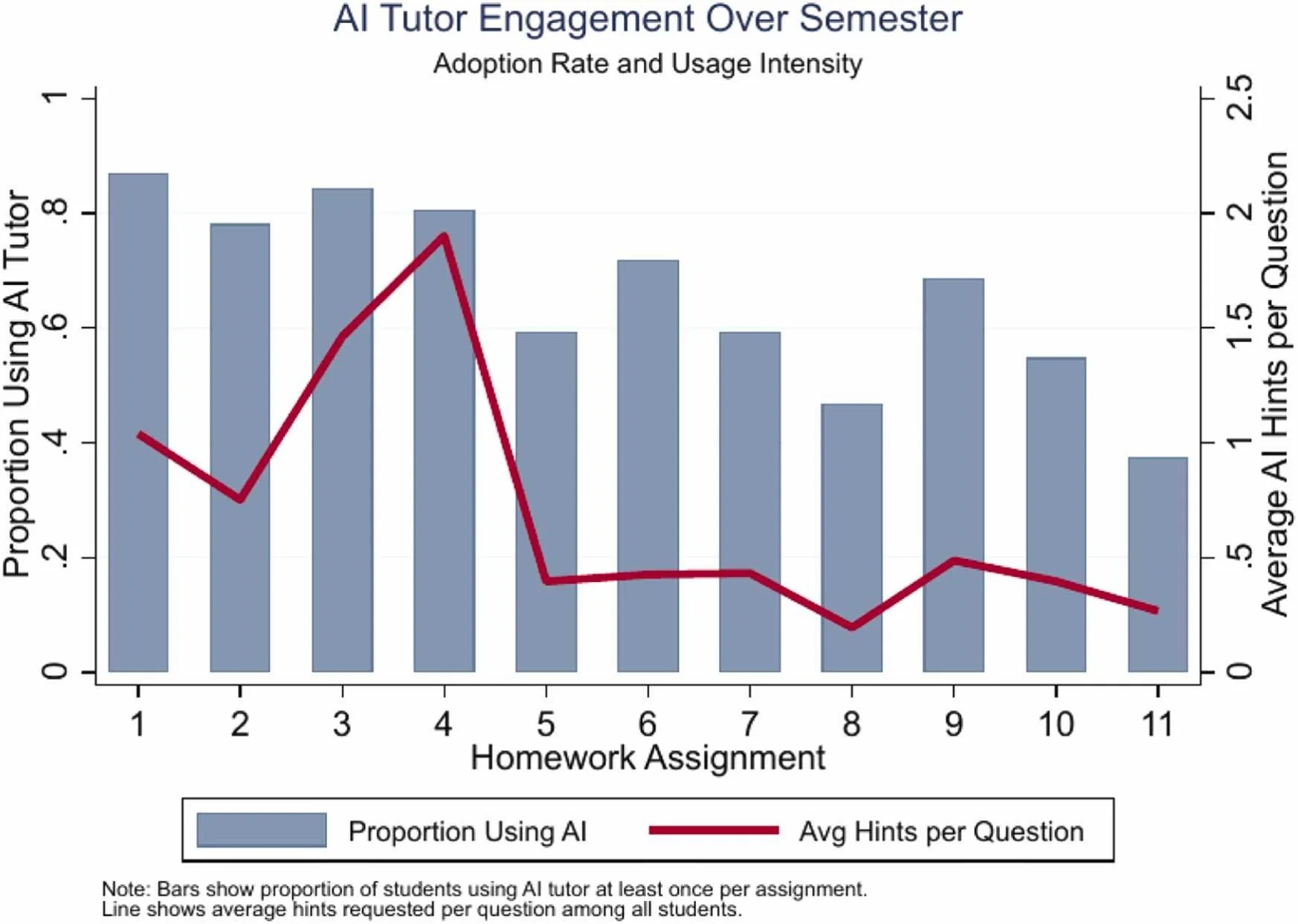
Abstract: I study whether an AI-Tutor embedded in the Macmillan Achieve homework platform improves learning outcomes for honors macroeconomic principles students. The setting provides assignment-level telemetry on 32 students across 11 homework assignments, linked to exams, course grades, and surveys. AI use was not associated with better grades. In the baseline fixed-effects model, each additional AI hint per question is associated with 0.683 more attempts per question, but not with higher homework scores, exam scores, or final course grades. Adoption was swift but short-lived: 87.1% of students requested at least one hint on the first homework, compared with 37.5% on the eleventh. Students using more hints tended to start homework earlier, but the extra activity did not translate into measured learning gains. Survey responses fit the same pattern. Nearly all surveyed students tried the tool (96.0%), but only 34.8% reported being satisfied with its performance. In this implementation, the AI-Tutor engaged students without improving learning outcomes, though the sample’s high baseline achievement may limit detection of small performance gains.

Abstract: In a recession, increased competition forces inexperienced job market entrants to accept lower wages than those who start their careers during an economic boom. Despite years of improvement in labor market conditions following a recession, a wage disparity, known as scarring, persists between these cohorts. Recently implemented Salary History Ban laws (SHBs) are intended to reduce wage disparities between advantaged and disadvantaged groups. In this study, I test how these laws affect a unique and often less salient disadvantaged group – scarred workers. For scarred workers who began their careers during a moderate-to-severe recession, or a five percentage point higher state unemployment rate, I find SHBs increase job mobility by 0.6%, hourly wages by 2.65%, and weekly earnings by 5% relative to cohorts who graduated in baseline labor market conditions. These estimates represent a substantial reduction in the original scarring effect and provide a broader understanding of the mechanisms behind both scarring and SHB laws.

Abstract: Are there long-term labor consequences in migrating to the US during a recession? For most immigrants, credibly estimating this effect is difficult because of selective migration. Some immigrants may not move if economic conditions are not favorable. However, identification is possible for refugees as their arrival dates are exogenously determined through the US Refugee Resettlement program. A one percentage point increase in the arrival national unemployment rate reduces refugee wages by 1.98% and employment probability by 1.57 percentage points after 5 years.